
Built to Find Out: Astral, Sour, Manitou and the Mega Mullet Experiment
32 inches up front. 29 out back. 120 mm of travel. And plenty of unanswered questions. Exactly how we like it.
Words: Joshua Riddle / Photos: Kenny Buchanan

Some bikes are built to answer a market need. Others are built to answer a question.
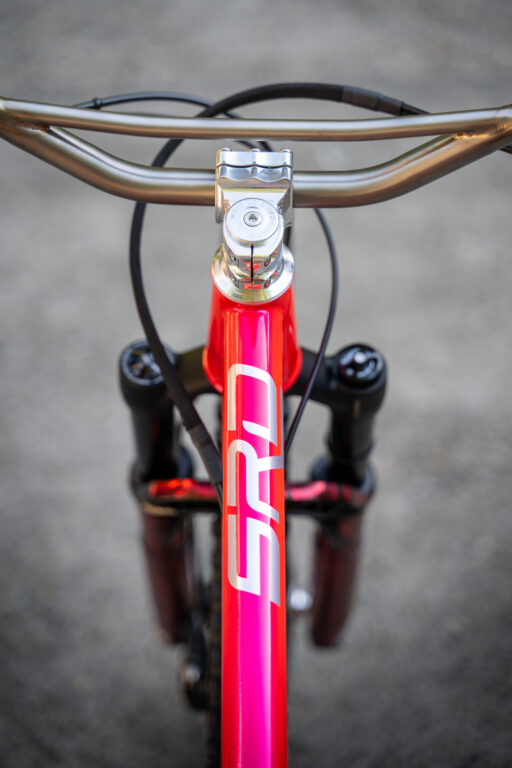
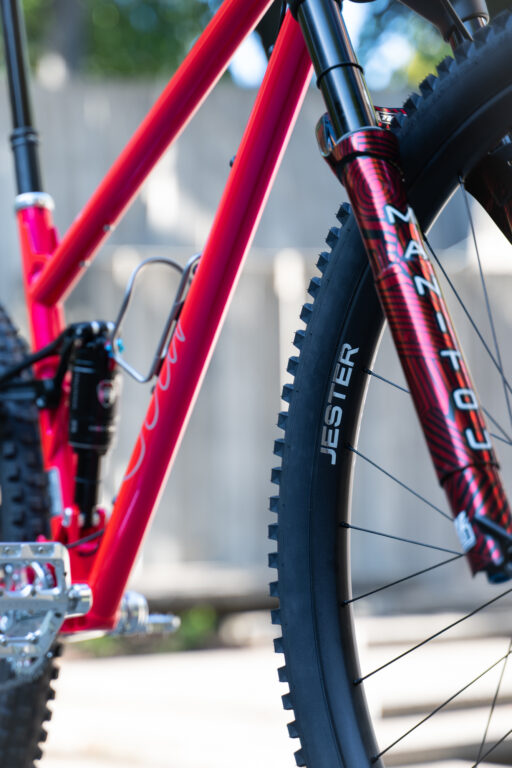
At MADE 2026, Sour Bicycles brought one of the latter. An eye-searing pink, steel, full-suspension prototype based on the Sour Double Choc, running a 32-inch front wheel, 29-inch rear wheel and 120 mm of travel at both ends.
Sour calls it the Mega Mullet. At the front is something equally experimental: Manitou’s camouflaged prototype 32-inch suspension fork. At the rear, a Manitou Mara Pro Inline completes a suspension package built for a bicycle whose geometry, handling and ultimate purpose are still being discovered. Sour’s description might be the best development brief imaginable:
“32” up front. 29” out back. 120 mm of travel. The rest, we’re still figuring out.”
Quite the opposite.
Changing something as fundamental as wheel diameter creates an enormous number of questions. Geometry changes. Loads change. Steering changes. Chassis requirements change. Packaging changes. The relationship between suspension, wheels, frame and rider changes with them.
You can’t properly answer those questions by developing a fork in isolation. You need bikes. You need different interpretations. You need riders. Most importantly, you need partners willing to build something without already knowing what the answer is going to be.
That’s why our ongoing relationship with Sour Bicycles has been so valuable. We’ve already explored the 32-inch concept together through the Pasta Party 32 hardtail. The Mega Mullet takes that experiment somewhere completely different. This time there is rear suspension. And this time only one wheel is enormous.
A 32-inch front wheel offers potential advantages in rollover and maintaining momentum through rough terrain. But larger wheels also create packaging and handling considerations, particularly when the objective moves away from outright XC efficiency toward something more playful.
So Sour and Astral tried something different. Keep the 32-inch wheel up front. Put a 29-inch wheel behind it. Add 120 mm of carefully controlled suspension at either end and see what happens.
Tester Loren described the result as considerably more playful and easier to get airborne than the five 32-inch hardtails he had previously ridden. After adapting to the bike, he found it stable at speed, capable on steep terrain and surprisingly natural despite the different wheel diameters.
In most situations, he said, he simply forgot they were different sizes. There are still questions. Tight uphill switchbacks exposed some of the differences between the two turning radii, and Loren estimates the concept is perhaps “75% there.” That’s precisely the point. A prototype that tells you everything you already know isn’t much of a prototype.
Quite the opposite.
Changing something as fundamental as wheel diameter creates an enormous number of questions. Geometry changes. Loads change. Steering changes. Chassis requirements change. Packaging changes. The relationship between suspension, wheels, frame and rider changes with them.
You can’t properly answer those questions by developing a fork in isolation. You need bikes. You need different interpretations. You need riders. Most importantly, you need partners willing to build something without already knowing what the answer is going to be.
That’s why our ongoing relationship with Sour Bicycles has been so valuable. We’ve already explored the 32-inch concept together through the Pasta Party 32 hardtail. The Mega Mullet takes that experiment somewhere completely different. This time there is rear suspension. And this time only one wheel is enormous.
A 32-inch front wheel offers potential advantages in rollover and maintaining momentum through rough terrain. But larger wheels also create packaging and handling considerations, particularly when the objective moves away from outright XC efficiency toward something more playful.
So Sour and Astral tried something different. Keep the 32-inch wheel up front. Put a 29-inch wheel behind it. Add 120 mm of carefully controlled suspension at either end and see what happens.
Tester Loren described the result as considerably more playful and easier to get airborne than the five 32-inch hardtails he had previously ridden. After adapting to the bike, he found it stable at speed, capable on steep terrain and surprisingly natural despite the different wheel diameters.
In most situations, he said, he simply forgot they were different sizes. There are still questions. Tight uphill switchbacks exposed some of the differences between the two turning radii, and Loren estimates the concept is perhaps “75% there.” That’s precisely the point. A prototype that tells you everything you already know isn’t much of a prototype.


“I also want to say how impressed I am with your suspension. The small bump compliance feels so good.”He ran the suspension relatively soft, finding that it ramped progressively through its travel without problematic bottom-outs. Even after pedaling the bike up a 1,000-meter climb on his first ride, he never felt the need to reach for a switch. That’s the kind of feedback development is ultimately about. Not specifications in isolation. What does the complete bike actually do underneath a rider?

We’ve been asking questions about suspension since mountain bike suspension itself was an unconventional idea. As disciplines emerged and evolved, suspension had to evolve with them. XC, downhill, freeride, dirt jump, trail and enduro each created different demands. Wheel diameters changed. Bikes became faster. Riders pushed further. And Manitou repeatedly explored solutions that didn’t necessarily follow the accepted blueprint. Sometimes the result has been immediately visible, like an inverted Dorado or our unmistakable Reverse Arch. Other times, the important differences are hidden inside.
The philosophy remains the same: Physics, not fashion. Thirty-two-inch wheels are simply the latest opportunity to apply it. We’re not interested in deciding that 32 inches is the future and then engineering backward from that conclusion.
We’re interested in finding out what it can do.
“Maybe it’s brilliant. Maybe it’s nonsense. Most likely, it’s somewhere in between.”We couldn’t agree more. Because innovation doesn’t begin with certainty. It begins when somebody is curious enough to build the thing, brave enough to ride it and open-minded enough to discover that some of their assumptions might have been wrong. The Mega Mullet already appears to be answering some questions. Loren found the smaller rear wheel helped address some of the packaging compromises he’d experienced aboard full 32-inch bikes on steep terrain and in the air. It wasn’t as outright fast as some of the 32-inch platforms he’d ridden, but he was equally clear that speed wasn’t its only objective. His description was considerably more entertaining: It’s “way better at partying.” For a pink 32/29 steel prototype built by Sour, that sounds about right.